NBI Clearance Sample 2026: What a Real Clearance Looks Like
Fact Checked: September 28, 2026 | Reviewed by: NBI Online Clearance PH Editorial Team | Reading Time: 13 minutes
Transparency Statement: NBI Online Clearance PH is an independent informational website. We are not affiliated with, endorsed by, or connected to the National Bureau of Investigation (NBI), the Department of Justice (DOJ), or any Philippine government agency. This guide provides educational information only. Any sample shown is for illustrative purposes. For official verification of a clearance, always use the NBI Clearance portal at clearance.nbi.gov.ph.
NBI Clearance Sample: Understanding What an Authentic Clearance Contains
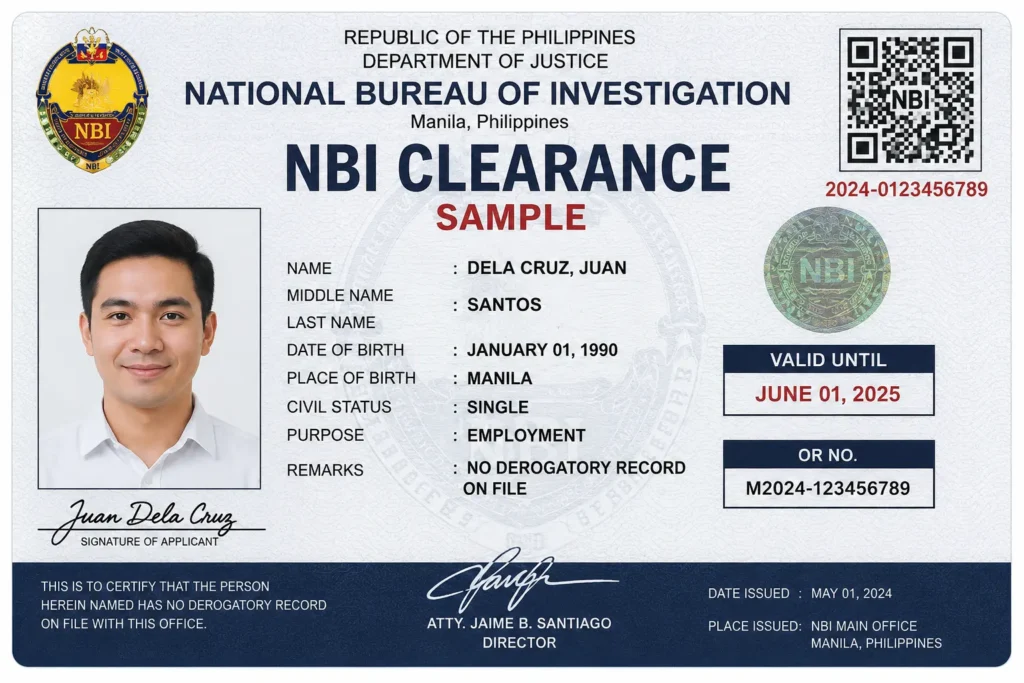
Before you receive your NBI Clearance, knowing what the actual document looks like helps you verify its authenticity, check for errors immediately, and understand what employers, embassies, and government agencies are reading when they review it. An NBI Clearance sample is an illustrative reference that shows the layout, fields, and security features of a genuine clearance issued by the National Bureau of Investigation.
This guide walks you through every part of a real NBI Clearance, field by field. You will learn what each line means, where the QR code is located, how the reference number is formatted, how the validity date is displayed, and what to do if you spot an error. Whether you are a first-time applicant who wants to know what to expect, or an employer verifying a clearance, this NBI Clearance sample guide covers everything.
Note that the NBI periodically updates the clearance design. The layout, fonts, and security features described here reflect the standard 2026 format. Always rely on the official NBI portal for the most current design specifications.
Key Takeaways
- An NBI Clearance has 9 core parts. Name, photo, signature, birthdate, civil status, address, reference number, QR code, and validity period.
- The QR code is the primary verification tool. Employers and agencies scan it to confirm authenticity against the NBI database.
- The reference number is unique to your application. It links your printed clearance to your online record.
- Validity is one year from issuance. The exact expiration date is printed on the document.
- Design varies slightly by branch. Regional offices may print on different paper or with slightly different layouts.
- Errors are easier to fix before leaving the branch. Check your sample details carefully at the releasing window.
Why You Need an NBI Clearance Sample Reference
A visual or descriptive NBI Clearance sample serves several practical purposes for both applicants and institutions.
For Applicants
- You know exactly what to expect when your clearance is released, reducing anxiety on appointment day.
- You can spot errors immediately—wrong spelling, incorrect birthdate, mismatched address—before leaving the branch.
- You understand what each field means, so you can provide accurate information during application.
- You know what to protect from loss, damage, or unauthorized copying.
For Employers and Agencies
- You know which fields to inspect when reviewing a submitted clearance.
- You understand how to verify authenticity using the QR code.
- You recognize legitimate variations between NBI branches and paper types.
- You can quickly spot suspicious or altered documents.
9 Parts of a Real NBI Clearance
Every authentic NBI Clearance contains the following nine components.
| # | Part | Purpose |
|---|---|---|
| 1 | Full Name | Identifies the clearance holder |
| 2 | Photograph | Visual identification captured during biometrics |
| 3 | Signature | Matches the digital signature captured during the appointment |
| 4 | Date and Place of Birth | Personal identification details |
| 5 | Civil Status | Personal information for record matching |
| 6 | Address | Current residential address on file |
| 7 | Reference Number | Unique code linking the printed document to the NBI database |
| 8 | QR Code | Machine-readable verification element |
| 9 | Validity / Issuance Date | Shows when the clearance was issued and when it expires |
Field-by-Field Breakdown of an NBI Clearance Sample
Below is a detailed explanation of what each field on an NBI Clearance contains.
Full Name
The clearance displays your complete legal name as you entered it during the online application. It typically appears as Last Name, First Name Middle Name in uppercase letters. If you have a suffix (Jr., Sr., III), it appears after your name. This field must match your valid ID exactly for the clearance to be considered valid.
Photograph
Your photograph is captured digitally at the NBI branch during your biometrics appointment. It is a frontal facial image taken against a plain background. Eyeglasses are typically removed. The photo is printed directly onto the clearance and cannot be altered without damaging the document.
Signature
The signature printed on the clearance is the digital signature you provided during your appointment. It should match your ID signature. Employers and agencies compare this against your other documents for consistency.
Date and Place of Birth
This field shows your birthdate in standard Philippine format (Month DD, YYYY) and your place of birth (city or municipality and province). Any mismatch with your PSA birth certificate or valid ID should be reported immediately.
Civil Status
Your recorded civil status appears here—Single, Married, Widowed, or Separated. Update this information in your NBI record if your status changes between applications.
Address
The address printed is the current residential address you entered during your online application. This may differ from your permanent address if you provided separate entries.
The QR Code and How It Works
The QR code is the most important security feature of a modern NBI Clearance. It appears as a square two-dimensional barcode printed near the bottom or side of the document.
What the QR Code Contains
- Your reference number
- A verification link or token
- Encrypted identifiers linking the document to the NBI database
How to Use the QR Code
- Open any QR scanning app on a smartphone.
- Point the camera at the QR code.
- The app decodes the code and displays or links to the verification information.
- The information should match the printed fields on the clearance.
Employers and government agencies use this feature to quickly confirm that a submitted clearance is authentic and not expired.
Understanding the NBI Clearance Reference Number
The reference number is a unique alphanumeric code assigned to your specific application. It typically appears in a prominent location on the clearance, often near the top or beside the QR code.
Format
The reference number usually consists of letters and digits, sometimes separated by hyphens. The exact format is determined by the NBI system and may change slightly over time. Do not attempt to decode it manually—its meaning is only accessible through the NBI database.
Where Else to Find It
- In your appointment confirmation email
- On your appointment confirmation page
- In your NBI Clearance online account under “My Appointments”
Keep this number safe. If you lose your clearance and need a replacement, having the reference number simplifies the process. See Lost NBI Clearance for replacement guidance.
Reading the Validity Date on Your NBI Clearance
The validity date is printed near the reference number. An NBI Clearance is generally valid for one year from the date of issuance, unless otherwise indicated.
Format
The date appears in standard Philippine format, for example: Valid Until: September 28, 2027. Some clearances also display the issuance date, which is the date the document was printed.
Why Validity Matters
- Employers require a clearance that is valid on the date of submission or onboarding.
- Embassies and visa processing centers often require clearances issued within the last six months.
- Expired clearances cannot be “extended.” You must apply for a new one. Read NBI Clearance validity for full details.
Sample Text Representation of an NBI Clearance
The following is a textual illustration of how an NBI Clearance sample is laid out. It does not represent an actual clearance and contains no real personal data.
| Field | Sample Entry |
|---|---|
| Document Title | NATIONAL BUREAU OF INVESTIGATION CLEARANCE |
| Full Name | DELA CRUZ, JUAN SANTOS |
| Date of Birth | January 15, 1995 |
| Place of Birth | Quezon City, Metro Manila |
| Civil Status | Single |
| Address | 123 Sample Street, Barangay Sample, Quezon City |
| Reference Number | NBI-XXXX-XXXX-XXXX |
| Date Issued | September 28, 2026 |
| Valid Until | September 28, 2027 |
| QR Code | [QR Code Image] |
Use this layout as a reference when reviewing your own clearance. Every field should match your application data and your valid ID.
Security Features to Look For on an Authentic NBI Clearance
Authentic NBI Clearances include several subtle security features that make them difficult to counterfeit.
- Background pattern: A fine, complex design that is difficult to photocopy cleanly.
- Watermark: A faint NBI logo or text visible when held against light.
- Micro-printing: Tiny text, sometimes visible only under magnification.
- QR code: A scannable code that links to NBI verification.
- Unique reference number: A code that cannot be duplicated legitimately.
- Special paper: Clearance paper is slightly textured and reacts to handling differently from ordinary bond paper.
How to Spot a Fake NBI Clearance
Fake clearances are occasionally sold by illegal fixers. Employers and agencies should watch for these warning signs:
- Blurry or pixelated QR code that does not scan properly.
- Inconsistent fonts or misaligned text fields.
- Poor print quality compared to official clearances.
- Missing security features such as watermark or background pattern.
- Wrong reference number format or suspiciously short code.
- Mismatched information between the printed fields and the QR code data.
- Price far below the official fee or claimed “processing” outside official channels.
If you suspect a fake clearance, report it to the NBI immediately. Never transact with unofficial “fixers” offering faster clearance issuance. All official processing goes through clearance.nbi.gov.ph.
How Employers Verify Your NBI Clearance
Employers typically verify NBI Clearances using three methods:
- QR code scanning: The simplest method. Scan the QR code and compare the displayed data against the printed fields.
- NBI portal verification: Some employers use the official NBI verification system to confirm the reference number.
- Direct contact with NBI: For high-security roles, employers may contact the NBI directly to confirm clearance validity.
Ensure that your submitted clearance is original, unaltered, and unexpired. Providing a falsified clearance is a criminal offense. Learn more in our NBI Clearance verification guide.
Common Printing Errors on NBI Clearance Samples
Occasionally, clearances are printed with errors due to typos in your application or technical issues at the branch. Common errors include:
- Misspelled name
- Wrong birthdate
- Incorrect civil status
- Old or incomplete address
- Mismatched signature
- Blurred photograph
Inspect your clearance carefully at the releasing window. Report any error immediately so the branch can correct and reprint it. Once you leave the branch, correcting errors requires a new visit and may involve additional verification. For persistent issues, refer to our NBI Clearance problems and solutions guide.
Frequently Asked Questions About NBI Clearance Samples
- What does an NBI Clearance look like?
- An NBI Clearance is a single-page document containing your name, photograph, signature, birthdate, civil status, address, reference number, QR code, issuance date, and validity date.
- Is the NBI Clearance design the same everywhere?
- Core fields are consistent, but paper, layout, and minor design details may vary between regional offices and satellite branches.
- Where is the QR code located on an NBI Clearance?
- It is typically printed near the lower portion or side of the document. Scan it with a QR reader to verify authenticity.
- How do I know if my NBI Clearance is genuine?
- Check the QR code scans correctly, the reference number matches your application, and the document has proper print quality and security features.
- Can I photocopy my NBI Clearance?
- You can photocopy it for your own records, but photocopies are not accepted as originals for most official transactions. See requirements.
- Where is the reference number on an NBI Clearance?
- It appears prominently, usually near the top or beside the QR code.
- How do I read the validity date on my NBI Clearance?
- Look for “Valid Until” followed by a date, typically one year from issuance.
- What should I do if my NBI Clearance has a wrong name?
- Report it immediately at the releasing window. If you already left the branch, return with your birth certificate and valid ID to request a correction.
- Can I verify someone else’s NBI Clearance?
- Employers and agencies can verify clearances submitted to them using the QR code. Private individuals generally cannot verify clearances that do not belong to them.
- Are NBI Clearances issued on paper or digital format?
- The standard clearance is printed on security paper. A digital version can be accessed through the NBI portal and may be accepted by some institutions.
- How long is an NBI Clearance valid?
- One year from the date of issuance, unless otherwise indicated on the document.
- What if the QR code on my clearance does not scan?
- Try a different scanning app or device. If it still fails, contact the issuing NBI branch for verification.
- Do all NBI branches use the same paper?
- Most use similar security paper, but small variations may occur. Paper differences alone do not mean a clearance is fake.
- Can I request a new clearance with the same reference number?
- No. Each application generates a new reference number. Replacement clearances have new reference numbers.
- Is the photograph on the NBI Clearance taken at the branch?
- Yes. The photograph is captured during your biometrics appointment.
- Can I choose the photo that appears on my clearance?
- No. The photograph is taken on-site during biometrics and cannot be replaced or chosen.
- What if my clearance has a blurred photograph?
- Report it at the releasing window for a reprint. Blurred photos may cause verification issues later.
- How can I tell if my NBI Clearance has been altered?
- Altered clearances often show inconsistent fonts, mismatched fields, or tampered QR codes. Any suspicion should be reported to the NBI.
- Can I use an old NBI Clearance sample as a template?
- No. Never attempt to recreate or modify a clearance. This is illegal and carries serious penalties.
- Why is this guide not affiliated with the NBI?
- NBI Online Clearance PH is an independent informational resource. We provide educational references but are not part of the NBI and cannot issue or verify official clearances.
Official References
Conclusion: Use This NBI Clearance Sample as Your Reference
Knowing what an authentic NBI Clearance looks like empowers you to verify the document you receive, spot errors immediately, and protect yourself from counterfeit clearances. Use this NBI Clearance sample guide as your reference when applying, when checking your released clearance at the branch, and when reviewing a clearance submitted to your organization. Always rely on the official NBI portal for the most current clearance design and verification tools.
Disclaimer: NBI Online Clearance PH is an independent informational resource. The sample shown and described is illustrative only and does not represent an actual NBI Clearance. Always refer to the official NBI portal for authoritative verification.