NBI Clearance for OFWs: The Complete 2026 Guide to Applying from Abroad
Last Updated: ·
Fact-Checked: Cross-referenced with official NBI, DMW, and DFA guidelines for overseas applicants ·
Reading Time: 25 minutes
Quick Answer: Can OFWs Get an NBI Clearance While Working Abroad?
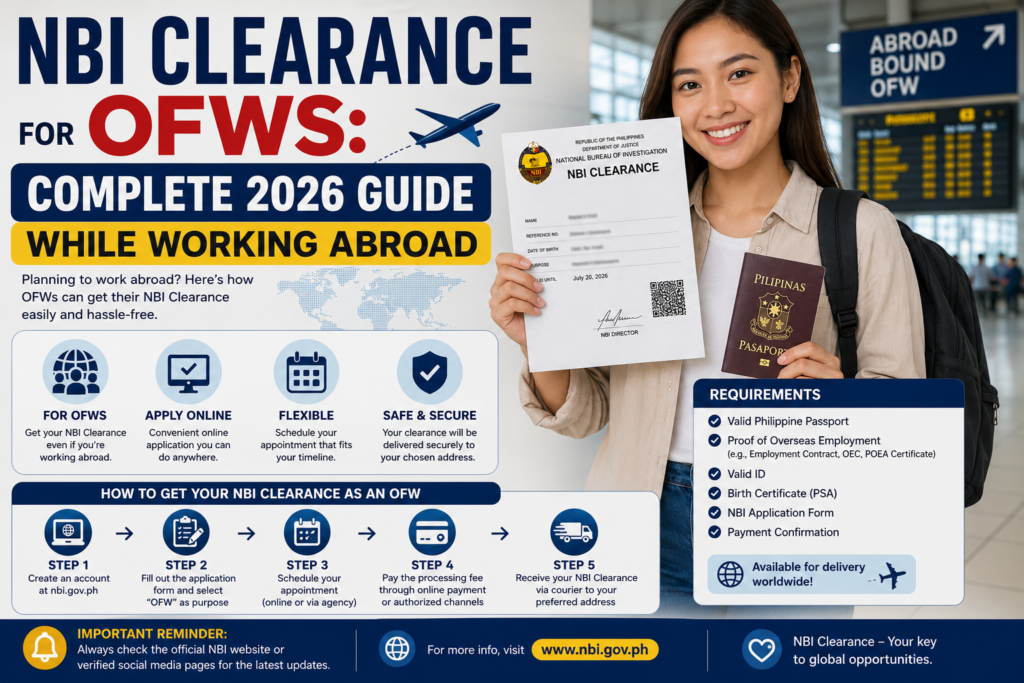
Yes. An Overseas Filipino Worker can apply for, renew, and claim an NBI Clearance without returning to the Philippines. The NBI allows OFWs to process their clearance through an authorized representative, using the official NBI Form No. 5 and a Special Power of Attorney (SPA). This process involves capturing your fingerprints on a standardized fingerprint card, having it authenticated by the nearest Philippine Embassy or Consulate, and sending it to your trusted representative in the Philippines. The representative can then complete the application, pay the fee, and claim the clearance on your behalf. This guide explains every single step in detail.
Important Disclaimer: NBIOnlineClearance.ph is an independent informational resource. We are not affiliated with the National Bureau of Investigation (NBI), the Department of Migrant Workers (DMW), the Department of Foreign Affairs (DFA), or any Philippine government agency. This guide is created to help OFWs understand and navigate the official process. All official transactions must be completed through the NBI’s official portal or at authorized Philippine government offices.
Key Takeaways for OFW NBI Clearance Applications
- OFWs can process their NBI Clearance from abroad through a trusted representative in the Philippines.
- The process requires a completed NBI Form No. 5, a fingerprint card, and a consular-authenticated Special Power of Attorney (SPA).
- Your fingerprints must be taken on the official NBI card and authenticated by the nearest Philippine Embassy or Consulate.
- The same process applies whether you are a first-time applicant or need to renew your NBI Clearance.
- Processing time depends on whether a HIT occurs. A HIT can cause a delay of 5 to 10 working days even for OFW applications.
What is an NBI Clearance for OFWs?
An NBI Clearance for OFWs is the same powerful government document issued by the National Bureau of Investigation, but with the specific purpose of Employment (Abroad). It is a mandatory requirement for the processing of an Overseas Employment Certificate (OEC), for visa applications, for foreign employer background checks, and for contract renewals. For an Overseas Filipino Worker, this clearance is not just a piece of paper. It is a critical link in the chain that allows you to legally work and reside in a foreign country. A valid NBI Clearance assures your foreign employer and the host country’s immigration that you have no criminal record in the Philippines.
The unique challenge for OFWs is the physical distance. The NBI Clearance process is highly biometric, requiring fingerprints and a photo. For an OFW who cannot easily fly home, the NBI has established a special remote process using the NBI Form No. 5, a fingerprint card, and a Special Power of Attorney. This process transforms a seemingly impossible task into a manageable, step-by-step procedure. Understanding this procedure is your first and most important task when your employer or agency asks for an updated NBI Clearance.
Who Needs an NBI Clearance as an OFW?
The requirement for an NBI Clearance is not a one-time event in an OFW’s career. It recurs at several critical junctures. You will almost certainly need one in the following situations.
- First-Time OFWs: When applying for your first overseas job, the NBI Clearance is a core requirement of the Department of Migrant Workers (DMW) for the issuance of your OEC.
- Contract Renewal: Foreign employers and immigration departments often demand a newly issued NBI Clearance as part of the work permit or contract renewal process, even if you have been continuously employed.
- Changing Employers Abroad: If you are switching to a new foreign employer, they will require a fresh background check, making an updated NBI Clearance mandatory.
- Applying for Permanent Residency or Citizenship: The immigration authority of your host country will require a recent NBI Clearance as a core part of the permanent residency or naturalization application package.
- Applying for a Foreign Visa (for family or tourism): If your spouse or child is applying for a visa to join you, they may need to present an NBI Clearance, or you may need one for their application.
For all these scenarios, having your NBI Clearance expire while you are abroad can be stressful. The process outlined here is designed to help you secure it smoothly. Review our detailed NBI Clearance for Employment guide for local and overseas employment basics.
NBI Form No. 5: The Cornerstone of the OFW Application
NBI Form No. 5 is the official “Application for Clearance for Persons Abroad.” It is the specific form designed for Filipinos who are outside the country and cannot personally appear at an NBI branch for biometric capture. This form replaces the in-person biometrics process. It is the central document that your representative will submit to the NBI on your behalf. The form must be filled out completely and accurately. It captures your full name, date and place of birth, your foreign address, passport details, and the purpose of your clearance. Most critically, it is the designated space where your official rolled fingerprint impressions are captured.
NBI Form No. 5 is the official remote application form. It must be accompanied by clear, rolled fingerprint impressions and be authenticated by a Philippine Embassy or Consulate.
The Fingerprint Card Process: Getting Your Prints Abroad
The quality of your fingerprint impressions is the single most critical success factor for your OFW NBI Clearance application. Smudged, incomplete, or incorrectly taken fingerprints will result in the outright rejection of your NBI Form No. 5, wasting weeks of time and money. There are three primary ways to get your fingerprints taken correctly while overseas.
- At the Philippine Embassy or Consulate: This is the most reliable method. Most Philippine foreign service posts have trained personnel and the official NBI fingerprint card forms. You book an appointment, present your passport, and they capture your fingerprints directly on the form. They then authenticate the form.
- At a Local Police Station: You can go to a police station in your host country and request to have your fingerprints taken on the NBI fingerprint card. The officer must sign the card. After this, you must take the signed card to the Philippine Embassy for authentication.
- Through a Private Fingerprinting Agency: In many countries, certified private agencies can capture fingerprints for legal purposes. Ensure they are a recognized entity and that the Philippine Embassy will accept their work for authentication.
The fingerprint impressions must be rolled, not flat. Each finger is individually rolled from nail to nail on the ink pad and then onto the designated box on the card. A simultaneous impression of all four fingers from each hand is also required at the bottom of the card. If the fingerprints are rejected by the NBI’s automated fingerprint identification system, your representative will be notified, and you will have to redo the entire process.
Special Power of Attorney (SPA) for Your NBI Clearance
A Special Power of Attorney is a legal document that grants another person, your representative, the authority to act on your behalf for a specific purpose. In this case, the purpose is to apply for and claim your NBI Clearance. The NBI requires a notarized and consularized SPA for all transactions done through a representative. A general SPA or a simple authorization letter is not acceptable. The SPA must explicitly state that the representative is authorized to apply for, process, and claim your NBI Clearance. It must include your full name, passport number, and the full name of your representative. You can have the SPA drafted and notarized at the Philippine Embassy or Consulate. The consular officer will authenticate your signature, making it a valid legal document for use in the Philippines. This authenticated SPA, along with your completed NBI Form No. 5, forms the legal basis for your representative to act on your behalf.
How Your Representative Claims Your NBI Clearance
Once you have couriered all your original, authenticated documents to your representative in the Philippines, their task begins. Here is what they must do. They must go to the NBI branch with your appointment reference number, the authenticated NBI Form No. 5 with your original fingerprints, the authenticated SPA, a photocopy of your passport data page, and two of their own valid government-issued IDs. They will present these at the verification counter. The NBI officer will scrutinize all documents, particularly the quality of the fingerprints and the SPA. If everything is in order, the representative will proceed to pay the required fee and complete the submission. The clearance will then be processed. Once released, your representative must present their valid ID again and the official receipt to claim the physical NBI Clearance document. They can then courier it to you anywhere in the world.
Complete Document Checklist for an OFW NBI Clearance
Preparing a complete and flawless document package is essential. A single missing signature or expired document will send your representative home empty-handed. Use this checklist to ensure nothing is overlooked.
| Document | Purpose | Key Condition |
|---|---|---|
| Duly Accomplished NBI Form No. 5 | Main remote application form with fingerprints. | Must have original, rolled, clear fingerprints. No erasures. |
| Authenticated Special Power of Attorney | Grants legal authority to your representative. | Must be notarized and consularized by the Philippine Embassy. |
| Photocopy of Valid Philippine Passport | Proof of identity and citizenship. | Data page must be clear and readable. Passport must be valid. |
| Two Valid IDs of the Representative | For identity verification at the NBI branch. | Must be original, valid government-issued IDs. |
| Online Appointment Reference Number | Proof of scheduled transaction. | Provide a printed copy or a clear digital screenshot. |
Accepted Valid IDs for the OFW Process
For the OFW yourself, your valid Philippine Passport is the primary and most important ID. If your passport has expired, you must renew it at the Philippine Embassy first. For your representative in the Philippines, they must present two valid government-issued IDs. These can be a PhilSys National ID, Driver’s License, UMID, PRC ID, or a Voter’s Certification. A company ID is not accepted. They must be original and valid. Review the complete list of accepted NBI valid IDs before their visit to the NBI branch.
Step-by-Step OFW NBI Clearance Application Process
This is the definitive remote application workflow. Follow each step meticulously to secure your clearance without unnecessary delay.
Step 1: Secure an NBI Clearance Appointment Online
You or your representative must first book an appointment through the NBI Clearance online portal. Create an account under your name and select the purpose Employment (Abroad). Book a schedule at the NBI branch most convenient for your representative. Secure the reference number.
Step 2: Download and Complete NBI Form No. 5
Download the official NBI Form No. 5 from the NBI website. Fill in all details accurately. Do not sign it yet; you must sign in the presence of the consular officer.
Step 3: Have Your Fingerprints Captured
Go to your nearest Philippine Embassy, a local police station, or an accredited agency. Have your rolled fingerprints captured directly on NBI Form No. 5. The capturing officer must sign the card.
Step 4: Authenticate Documents at the Philippine Embassy
Bring the completed NBI Form No. 5, your draft SPA, and your valid passport to the Philippine Embassy. Pay the authentication fees. Sign both documents in front of the consular officer. The embassy will then stamp and authenticate them.
Step 5: Courier the Original Documents to Your Representative
Use a secure, trackable international courier service like DHL, FedEx, or LBC to send the original authenticated NBI Form No. 5, the original authenticated SPA, and a clear photocopy of your passport to your representative in the Philippines.
Step 6: Representative Completes the Submission at the NBI Branch
On your appointment date, your representative goes to the NBI branch with all your original documents, the appointment reference, and their two valid IDs. They submit the package and pay the ₱155 fee.
Step 7: Check for a HIT and Claim the Clearance
If there is no HIT, the clearance is released on the same day. Your representative claims it. If there is a HIT, they will be given a return date. Once claimed, your representative should courier the NBI Clearance to you abroad.
Processing Through the Philippine Embassy or Consulate
For OFWs in major cities with a Philippine Embassy or Consulate, the process can be smoother. The consulate is a one-stop shop for authentication. They have the correct fingerprint cards, they can notarize your SPA, and they can authenticate all documents. Some consulates even have a direct liaison or a dedicated OFW assistance desk that can guide you through the NBI Form No. 5 process. Always check your local Philippine Embassy’s website first. They often have a dedicated page for “NBI Clearance Application,” which outlines the specific appointment process, fees, and schedule for fingerprinting services. This is the most reliable path and the one least likely to result in rejected documents.
NBI Clearance Fees and Other Costs for OFWs
The NBI Clearance fee itself is the smallest part of the total cost. The standard fee is ₱155. However, the total expense for an OFW includes the Philippine Embassy’s authentication fee for the NBI Form No. 5 and SPA, which typically ranges from $25 to $50 USD per document. There is also the cost of the international courier, which can be substantial. Budget for courier fees both ways: sending the documents to the Philippines and sending the clearance back to you. While the NBI fee is fixed and affordable, the ancillary costs of being an OFW applicant are significantly higher. Check our detailed NBI Clearance fee guide for the core cost and payment options like GCash for your representative’s convenience.
Processing Time and Release for Your OFW NBI Clearance
The processing time is governed by the same HIT rule as any other NBI application. If there is no HIT on your name, the clearance is released on the same day your representative submits the documents. If a HIT occurs, which is common for many Filipino surnames, a mandatory manual verification period of 5 to 10 working days is imposed. For an OFW on a tight contract renewal deadline, this delay can be critical. This is why it is an absolute expert rule to begin the process at least 4 to 6 weeks before you actually need the physical document in your hand. This buffer accounts for courier time, embassy appointment lead times, and a potential HIT delay. Learn more in our NBI Clearance processing time guide.
Validity Period of Your NBI Clearance
An NBI Clearance is valid for one year from the date of issuance. For an OFW, this is a critical detail. Your foreign employer or immigration department will often require a clearance that is not more than 3 or 6 months old, even if it is technically valid for a full year. Always check the specific validity window required by the requesting entity. A clearance that has even a day past its validity date is an expired document and cannot be used. If yours is expiring, you must start the OFW renewal process. See our guide on NBI Clearance validity and expiration rules.
What to Do If Your Passport Has Changed
If you have recently renewed your Philippine passport, your old NBI Clearance is linked to your old passport number. You will need a new NBI Clearance with your new passport number. When you fill out NBI Form No. 5, use your new passport details. Your representative cannot use the old clearance. It is a different document and will not match your current identity document. This is a common scenario for long-term OFWs who renew their passport at the embassy. The old NBI Clearance becomes invalid the moment your passport number changes.
OFW-Specific Scenarios: Seafarers, Balikbayans, and Returning OFWs
NBI Clearance for Seafarers
Seafarers or seamen face a unique challenge due to their constantly changing location. The principle is the same, but the logistics are more complex. Seafarers often have their agency in the Philippines process their documents. In this case, the manning agency may serve as the representative. The seafarer must find a way to get their fingerprints taken at the next port of call, have them authenticated if possible, and send them to the agency. This requires close and proactive coordination with the agency’s liaison officer.
NBI Clearance for Balikbayans
A balikbayan, a Filipino citizen returning to the Philippines for a visit, has a golden opportunity. If you are visiting home, do not use the remote OFW process. It is far faster and simpler to apply in person. Book an online appointment during your stay, visit the NBI branch yourself, complete your biometrics, and secure your clearance personally. The remote process is only for those who cannot physically be in the Philippines.
NBI Clearance for a Returning OFW Who is Now Staying for Good
If you have returned to the Philippines permanently, you are no longer an overseas applicant. You should apply as a regular local applicant. Use the standard NBI Clearance online application and book a normal appointment. The OFW-specific process and NBI Form No. 5 are not applicable to you.
Common Mistakes OFWs Make in Their NBI Clearance Application
- Poor Quality Fingerprints: This is the number one reason for rejection. Smudged, flat, or incomplete fingerprints will force you to redo the entire Form No. 5 process.
- Unnotarized or Unauthenticated SPA: A plain power of attorney or a simple signed letter is useless. The NBI requires the red ribbon or apostille from the Philippine Embassy.
- Using an Expired Passport Copy: All documents must match a valid passport. If your passport is expired, the NBI Form No. 5 is invalid.
- Booking the Wrong Appointment Purpose: The appointment must be for “Employment (Abroad).” A local employment purpose will not be accepted for an OFW application.
- Not Giving the Representative the Correct Documents: Forgetting to include a clear photocopy of your passport or the signed fingerprint card will stop the process immediately.
Expert Tips for a Smooth OFW NBI Clearance Application
- Start Very, Very Early: Begin the process 6 to 8 weeks before your deadline. This provides a generous buffer for consulate appointments, courier delays, and an NBI HIT.
- Always Use the Embassy for Fingerprints: Pay the extra fee at the Philippine Embassy for fingerprinting. Their work is almost never rejected because they know the NBI’s standards.
- Track Your Courier Religiously: Never send original, one-of-a-kind authenticated documents through ordinary mail. Use only DHL, FedEx, or a similar premium courier with full tracking and insurance.
- Choose a Highly Competent Representative: Your representative should be someone who is detail-oriented, patient, and has the time to go to the NBI branch. A simple misunderstanding on their part can cost you weeks.
- Have a Backup Plan for a HIT: Inform your employer or agency upfront that an NBI “HIT” is a standard name-matching procedure that can delay the clearance by up to two weeks. Transparency manages expectations and reduces your stress.
Frequently Asked Questions: NBI Clearance for OFWs
Can I get an NBI Clearance while working abroad?
Yes. By using the official NBI Form No. 5 process, a Special Power of Attorney, and a Philippine Embassy-authenticated fingerprint card, you can apply through a representative in the Philippines.
What is NBI Form No. 5?
It is the official application form for persons abroad. It contains your personal information and designated spaces for your rolled fingerprint impressions.
Can I renew my NBI Clearance online as an OFW?
You cannot complete the full renewal purely online without biometrics. If your fingerprints are still valid in the NBI system from a previous clearance, you may be able to use the NBI Quick Renewal. If not, you must use the NBI Form No. 5 process.
Can my spouse or parent claim my NBI Clearance?
Yes, provided you have executed a valid, consularized Special Power of Attorney specifically authorizing them to apply for and claim your NBI Clearance.
Do I need a Special Power of Attorney (SPA)?
Yes. A general authorization letter is insufficient. The NBI mandates a notarized and Philippine Embassy-authenticated SPA.
Where can I get my fingerprints taken abroad?
At the Philippine Embassy or Consulate, a local police station, or a private, accredited fingerprinting agency in your host country.
How much does the OFW NBI Clearance process cost?
The NBI fee is ₱155. The Philippine Embassy authentication fee is typically $25-$50 per document, plus international courier costs.
How long does the processing take?
Same-day release if no HIT. A HIT causes a mandatory delay of 5 to 10 working days. Factor in courier time.
Can I use my old NBI Clearance with my new passport?
No. Your NBI Clearance is tied to your passport number. If you have a new passport, you need a new NBI Clearance.
Is the process different for seafarers?
The core legal process is identical, but logistically, seafarers often coordinate through their manning agency in the Philippines, which acts as their representative.
Can a balikbayan apply for an NBI Clearance in the Philippines?
Yes. If you are visiting, apply in person at an NBI branch. It is faster, cheaper, and easier than the remote process.
What happens if my fingerprints are rejected?
Your representative will be notified. You must redo NBI Form No. 5 with a new, clear set of fingerprints and resubmit them.
Can I pay the NBI Clearance fee online from abroad?
Yes, you can pay online through GCash or other channels to secure the appointment. Your representative can also pay over the counter at the NBI branch.
Does the NBI Clearance for OFWs have the same validity?
Yes. It is valid for one year, the same as any other NBI Clearance.
What documents does my representative need to present?
They need the authenticated NBI Form No. 5, authenticated SPA, your passport photocopy, the appointment reference number, and their two valid IDs.
Is there an online interview for OFW applicants?
No. The process is document-based. There is no video call or online interview for the NBI Clearance OFW application.
Can I use the free first-time job seeker benefit as an OFW?
If you are a genuine first-time job seeker going abroad, you may qualify. However, the remote OFW process requires consular fees, so the NBI fee waiver is only one part of the cost. See our first-time job seeker guide.
What if my host country is not a member of the Apostille Convention?
You must still go through the Philippine Embassy for the traditional “red ribbon” authentication process. The embassy will guide you on their specific procedure.
Can a representative process my NBI Clearance without an SPA?
No. The SPA is the legal document that gives them the authority. The NBI will not transact with them without it.
Where can I get the official NBI Form No. 5?
It can be downloaded from the official NBI website. You can also obtain a copy at the Philippine Embassy or Consulate.
Is this website an official NBI or government site?
No. NBIOnlineClearance.ph is a private, independent informational guide. We are not affiliated with the NBI, DMW, DFA, or any Philippine government agency. Our mission is to provide clear, accurate information to help OFWs.
Why Trust This OFW NBI Clearance Guide
Our Commitment to Accuracy: This guide is the product of thorough research into the specific legal and procedural requirements faced by Overseas Filipino Workers. It is built on a foundation of verified official NBI procedures and consular practices.
Editorial Review and Fact-Checking
The NBI Form No. 5 process, SPA requirement, and Philippine Embassy procedures have been cross-referenced with official NBI memorandums and the general practices of Philippine foreign service posts. Our editorial team reviews this content quarterly to ensure it remains accurate for modern OFW needs.
Transparency: We are an independent resource. We clearly state our non-affiliation with the government. Our goal is to provide a reliable, free roadmap for OFWs navigating a complex bureaucratic process. Read our editorial policy for more on our content integrity.
Official References
For official, binding information and downloadable forms, always consult these primary sources:
- National Bureau of Investigation (NBI): For the official NBI Form No. 5 and clearance portal.
- Department of Migrant Workers (DMW): For OFW employment policies and OEC requirements.
- Department of Foreign Affairs (DFA): For the location and contact details of Philippine Embassies and Consulates worldwide.
- Philippine Embassy or Consulate in your host country: For the specific local procedure for authentication, notarization, and fingerprinting.
Structured Data Recommendations for Webmasters
To maximize this page’s visibility in search and AI-generated answers, we recommend implementing the following Schema.org types via JSON-LD:
- Article Schema: To mark up the main content with headline, author, and key dates.
- FAQ Schema: For the entire FAQ section, making it eligible for rich results and voice search.
- BreadcrumbList Schema: To define the site’s navigational path for search engines.
- HowTo Schema: To mark up the step-by-step OFW application process.
- Speakable Schema: To optimize the quick answer and key takeaways for voice assistant queries.
- GovernmentService Schema: Where appropriate, to mark up the description of the remote application service.