NBI Clearance vs Police Clearance: The Definitive 2026 Comparison for Filipinos
Last Updated: ·
Fact-Checked: Verified against official NBI and PNP issuances ·
Reading Time: 24 minutes
Quick Answer: What Is the Difference Between NBI Clearance and Police Clearance?
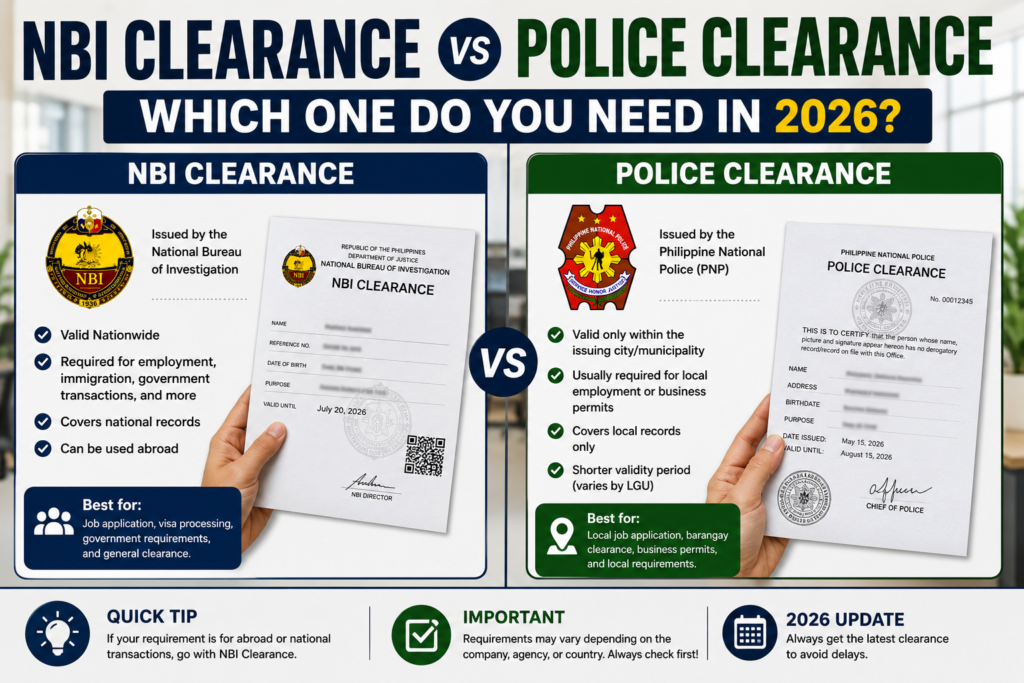
The fundamental difference between an NBI Clearance and a Police Clearance lies in the scope of their background check. An NBI Clearance is a nationwide document that searches the entire criminal database of the National Bureau of Investigation. A Police Clearance is a local document that only checks records within a specific city or municipality under the Philippine National Police. For most employment, travel, and government transactions, the NBI Clearance is the preferred and often mandatory document due to its comprehensive coverage.
Important Disclaimer: NBIOnlineClearance.ph is an independent informational resource. We are not affiliated with the National Bureau of Investigation (NBI), the Philippine National Police (PNP), or any government agency. This guide aims to clarify the differences between these two clearances. All official transactions must be completed on the respective official portals.
Key Takeaways: NBI Clearance vs Police Clearance
- The NBI Clearance provides a nationwide criminal record check, while the Police Clearance is limited to a single city or municipality.
- Most employers, government agencies, and foreign embassies require or strongly prefer the NBI Clearance due to its broader scope.
- A Police Clearance is typically faster and cheaper to obtain but has a more limited use case.
- Both clearances are valid for one year from the date of issuance.
- In many situations, a Police Clearance cannot replace an NBI Clearance, but the reverse is often true.
What is an NBI Clearance?
An NBI Clearance is an official government document issued by the National Bureau of Investigation. It serves as a powerful background check that verifies whether an individual has any criminal or derogatory records on file within the entire Philippine archipelago. The NBI maintains a centralized, nationwide database that consolidates records from Regional Trial Courts, Metropolitan Trial Courts, Municipal Trial Courts, the Office of the Prosecutor, and other law enforcement agencies across the country. This makes the NBI Clearance the gold standard for identity and background verification in the Philippines.
The document is secured through a biometrics-based system. Your fingerprints, photograph, and digital signature are captured at an NBI branch, making the clearance uniquely tied to your identity. The NBI Clearance is the most widely accepted clearance for employment, visa applications, professional licensing, and government transactions. Learn more about the full application process in our guide on how to apply for an NBI Clearance online.
What is a Police Clearance?
A Police Clearance is a certification issued by the Philippine National Police at the city or municipal level. It certifies that the applicant has no pending criminal cases or derogatory records within the jurisdiction of that specific police station. Unlike the NBI Clearance, the Police Clearance does not access a national database. It only checks the local police blotter and records maintained by that particular city or municipality. This makes it a localized document with a narrower scope, but it is often faster and simpler to obtain for local, non-national purposes.
Many local government units require a Police Clearance for business permits, local employment, or barangay-level transactions. While it is a valid government-issued ID for some purposes, its acceptance is limited when compared to the NBI Clearance, especially for national-level employment and international applications. For step-by-step instructions on securing one, see our police clearance online application guide.
NBI Clearance vs Police Clearance at a Glance
| Feature | NBI Clearance | Police Clearance |
|---|---|---|
| Issuing Authority | National Bureau of Investigation | Philippine National Police (Local Station) |
| Scope of Check | Nationwide | City or Municipality only |
| Validity | 1 year | 1 year |
| Cost | ₱155 (Standard) | Varies by LGU, typically ₱50–₱200 |
| Biometrics Required | Yes (Photo, Fingerprints, Signature) | Often minimal or none |
| Best For | Employment, Travel, Visa, Government | Local Business, Barangay, Minor Transactions |
Detailed Side-by-Side Comparison of NBI Clearance and Police Clearance
Issuing Authority and Governing Body
The NBI Clearance is issued by the National Bureau of Investigation, an agency under the Department of Justice. It operates on a national mandate. The Police Clearance is issued by the Philippine National Police at a local level, with each station maintaining its own records. The NBI’s centralized database makes its clearance significantly more powerful for comprehensive background checks.
Coverage and Database Scope
This is the most critical difference. The NBI Clearance checks a nationwide database that includes records from all courts and law enforcement agencies in the Philippines. A Police Clearance checks only the local blotter of the issuing station. If a person committed a crime in Cebu and applies for a Police Clearance in Manila, the PNP Manila station would not find that record. The NBI would. This nationwide scope is why the NBI Clearance is the mandatory document for employment and visa screening.
Application Process and Requirements
Both clearances require a valid government-issued ID. The NBI process is fully online-first through its official portal, requiring an appointment and biometric capture. The Police Clearance process can sometimes be a walk-in transaction at the city hall or police station, though many cities now also use online appointment systems. The NBI requirements are generally more stringent, always requiring at least two valid IDs, while local police may accept one.
Fees and Costs
The NBI Clearance has a fixed, nationwide fee of ₱155 for the standard service. The Quick Renewal with delivery costs ₱355. Police Clearance fees vary by Local Government Unit. They can range from as low as ₱50 to around ₱200. Some cities charge additional fees for the documentary stamp or certification.
Processing Time
An NBI Clearance can be released on the same day if there is no “HIT” on the applicant’s name. A HIT can delay it by 5 to 10 working days. A Police Clearance is typically issued within the same day, often within an hour, as the local blotter check is very fast. This makes the Police Clearance a quicker option when it is an accepted document.
Validity Period
Both the NBI Clearance and the Police Clearance are valid for one year from the date of issuance. This is a key similarity. An expired clearance of either type is not a valid document and must be renewed or replaced through a new application.
Purpose and Acceptance Comparison: Where to Use Each Clearance
Understanding the specific acceptance of each document is vital. Using the wrong one can result in a rejected application and wasted time.
| Purpose / Transaction | NBI Clearance | Police Clearance | Notes |
|---|---|---|---|
| Local Private Employment | Widely Accepted | Rarely Accepted | Most HR departments now require the nationwide NBI check. |
| Government Employment | Mandatory | Not Accepted | Civil Service rules require the NBI Clearance. |
| Overseas Employment (OFW) | Mandatory | Not Accepted | The DMW and foreign employers require the NBI clearance. |
| Visa Application (Tourist/Immigrant) | Required | Not Accepted | Embassies require a nationwide background check. |
| Passport Application (Special Cases) | Accepted | Not Accepted | See our guide on NBI Clearance for Passport. |
| Business Permit Application | Sometimes Required | Commonly Accepted | Often a local police clearance is sufficient for the Mayor’s Office. |
| Professional Licensing (PRC) | Required | Not Accepted | The Professional Regulation Commission requires NBI clearance. |
| Firearms License (LTOPF) | Required | May be Required in addition | PNP may require both a local police and national NBI clearance. |
| Barangay Clearance Requirement | Not Typically Required | Sometimes Required | A police clearance is a common prerequisite for a Barangay Clearance. |
Advantages of the NBI Clearance Over Police Clearance
The NBI Clearance holds significant advantages, which is why it is the standard for serious, official, and high-stakes transactions. Its nationwide scope makes it a far more powerful document.
- Nationwide Criminal Record Check: It searches records in every city, municipality, and court in the Philippines, leaving no jurisdictional blind spots.
- Universal Acceptance: It is accepted by virtually all employers, government agencies, foreign embassies, and licensing bodies.
- Biometric Security: The photo, fingerprints, and digital signature are stored nationally, making the document extremely difficult to counterfeit and easy for employers to verify with the QR code.
- Online Quick Renewal: Eligible applicants can renew their NBI Clearance from home via the NBI Quick Renewal service and have it delivered, a convenience not widely available for police clearances.
- Broader Purpose Validity: A single “Employment” purpose NBI Clearance can be used for multiple job applications within its validity year. A police clearance is often strictly local.
Advantages of the Police Clearance Over NBI Clearance
While the Police Clearance has a narrower scope, it possesses some practical advantages for specific, localized needs. It remains a useful document in many communities.
- Faster Processing: As it only checks a local blotter, it can often be issued in under an hour, compared to the potential multi-day wait for an NBI HIT resolution.
- Potentially Lower Cost: Depending on the city or municipality, a police clearance may be cheaper than the standard NBI fee.
- Local Accessibility: You can apply at your nearest police station or city hall, often without the need for a highly competitive online appointment slot.
- Sufficient for Local Government Transactions: For a mayor’s permit, local business license, or a simple barangay dispute settlement requirement, a police clearance is often perfectly sufficient.
- No “HIT” System Delay: There is no nationwide name-matching algorithm that could flag a common name and cause a manual review delay.
NBI Clearance vs Police Clearance: Which One Should You Choose?
The choice depends entirely on the requesting entity. The rule is simple: ask the person or office asking for it. However, a general guide follows.
Choose an NBI Clearance if you are:
- Applying for a job at a private company or corporation. An NBI Clearance for Employment is the HR standard.
- Applying for a position in the Philippine government.
- Processing an application for overseas employment as an OFW.
- Applying for a tourist, student, or immigrant visa to another country.
- Applying for a professional license from the PRC.
- Renewing a passport under special circumstances, such as a lost passport.
Choose a Police Clearance if you are:
- Applying for a local business or mayor’s permit.
- Fulfilling a specific local barangay requirement.
- Instructed to do so by a local court for a minor, local matter.
- An employer or agency specifically requests a “Police Clearance” by name.
When You Need Both an NBI and a Police Clearance
There are specific situations where a person must present both clearances. This can be confusing but is a standard requirement in some regulated fields.
- Firearms License (LTOPF): The PNP’s firearms and explosives office typically requires a Police Clearance from your city, a Barangay Clearance, and an NBI Clearance. The combination of both local and national checks provides a layered background investigation.
- Certain High-Security Government Positions: Some sensitive roles in the judiciary, law enforcement, or military may require a full suite of clearance documents, starting from the barangay level up to the national NBI level.
- Adoption and Guardianship Proceedings: Courts handling family law cases often demand both local and national clearances to ensure the child’s safety and the guardian’s fitness. This includes an NBI Clearance, a Police Clearance, and a Barangay Clearance.
Common Myths About NBI and Police Clearances
- Myth: “A Police Clearance is just as good as an NBI Clearance.” False. A police clearance is strictly local. It cannot serve as a replacement for an NBI clearance for national or international purposes.
- Myth: “An NBI Clearance replaces a Police Clearance in all cases.” Not always. A local mayor’s office or a barangay may still specifically mandate a police clearance from their own city, due to local ordinance.
- Myth: “Getting a HIT on my NBI means I have a criminal case.” This is a very common fear. A HIT only means you share a name with someone who has a record. It is a flag for manual verification, not a judgment.
- Myth: “I can use my expired clearance if I explain it’s for an urgent job.” No. An expired document is invalid. No legitimate employer or agency will accept an expired NBI or Police Clearance.
Common Mistakes When Applying for Clearances
- Securing the wrong document: Applying for a Police Clearance when the employer specifically requires an NBI Clearance is a waste of time and money. Always clarify the requirement first.
- Applying at the wrong police station: You must apply for a Police Clearance at the station that has jurisdiction over your current place of residence. Applying elsewhere will result in a rejection.
- Mismatched information: Your name on the application form must perfectly match your valid ID. A single letter discrepancy can and will cause your application to be denied.
- Forgetting to renew on time: Waiting until the day before your clearance expires to secure a new appointment can leave you with an invalid document during a critical application period.
Expert Tips for Choosing and Securing the Right Clearance
- Always Ask the Requester First: Before spending time and money, send a quick email or message to the HR department, embassy, or licensing office to confirm exactly which clearance they need.
- Default to the NBI Clearance: If an employer or agency asks for a “background check” or a “criminal record check” without specifying, they almost always mean the NBI Clearance. It is the safer, more comprehensive choice.
- Get Both Proactively: If you are entering a heavily regulated field or plan to start a business while job hunting, having both a valid NBI Clearance and a recent Police Clearance on hand will make you exceptionally well-prepared.
- Secure Your NBI Clearance Early: Because a common name can cause a HIT and a 5–10 day delay, don’t leave your NBI Clearance application to the last minute. Apply at least two weeks before your deadline.
- Use the Online System: Both clearances now offer online appointment systems. Avoid fixers and walk-in hassles by using the official NBI clearance online portal or your LGU’s official site.
Frequently Asked Questions: NBI Clearance vs Police Clearance
What is the main difference between NBI Clearance and Police Clearance?
An NBI Clearance is a nationwide criminal record check, while a Police Clearance only checks records in a specific city or municipality.
Can a Police Clearance replace an NBI Clearance for employment?
Almost never for formal employment. Most private companies and all government agencies specifically require the nationwide NBI Clearance for job applications.
Is the NBI Clearance or Police Clearance better?
The NBI Clearance is better for national and international purposes. The Police Clearance is faster and cheaper for strictly local, city-level transactions.
Can I use an NBI Clearance instead of a Police Clearance?
Often, yes. An NBI Clearance is generally accepted in place of a Police Clearance, but you must always verify with the specific office requesting it. A local mayor’s office may still demand a local police clearance.
Which is more expensive, NBI or Police Clearance?
The NBI Clearance has a fixed fee of ₱155. Police Clearance fees vary by city, ranging from about ₱50 to ₱200. They can sometimes be cheaper or slightly more expensive.
Which is processed faster?
A Police Clearance is typically faster, often issued within an hour. An NBI Clearance is same-day if there’s no HIT, but a HIT can delay it by 5-10 working days.
How long are both clearances valid?
Both the NBI Clearance and the Police Clearance are valid for one year from the date of issuance.
Do I need both an NBI and a Police Clearance?
Generally, no. However, for specific cases like firearms licensing (LTOPF) or certain high-security roles, you may be required to submit both.
Can I apply for an NBI Clearance without a valid ID?
No. You must present at least two valid government-issued IDs. Check the list of accepted IDs. The same generally applies to Police Clearances, though they may sometimes accept one.
Is a Police Clearance accepted for visa applications?
No. Foreign embassies require the nationwide background check provided only by the NBI Clearance.
What is a HIT on an NBI Clearance?
A HIT means your name matches a name in the criminal database. It triggers a manual verification and is common for people with popular names. It does not mean you have a criminal record. Learn more in our NBI HIT status guide.
Can I renew both clearances online?
You can renew your NBI Clearance online if you qualify for the Quick Renewal service. Some progressive LGUs also offer online renewal for Police Clearances, but this is not yet universal.
Can a fresh graduate use a Police Clearance for their first job?
No. An employer will almost certainly ask for an NBI Clearance for Employment. A fresh graduate can avail of the free first-time job seeker NBI Clearance under RA 11261.
Are both clearances valid IDs?
Yes, both the NBI Clearance and the Police Clearance are recognized as secondary government-issued IDs. However, the NBI Clearance is more universally accepted as a valid ID.
Where do I get a Police Clearance?
You must apply at the PNP station that has jurisdiction over your city or municipality of residence.
Is the application process different for OFWs?
Yes, but the fundamental document required is the NBI Clearance with the purpose “Employment Abroad.” A local Police Clearance is not accepted for OFW processing by the DMW.
What happens if my name is common? Which clearance should I get?
Even with a common name, you still likely need an NBI Clearance. Anticipate a HIT and plan your application timeline accordingly. A Police Clearance may be faster but might not be accepted for your purpose.
Can I use an NBI Clearance for a passport?
In specific special cases, yes. The DFA requires an NBI Clearance for applicants with a PSA “No Record” certificate or a late-registered birth. A Police Clearance is not accepted for this. Read our guide on NBI Clearance for passport.
Is a Barangay Clearance the same as a Police Clearance?
No. A Barangay Clearance is an even more local document verifying residency and good moral character within a barangay. It is often a prerequisite to get a Police Clearance.
Do I need a Police Clearance if I already have an NBI Clearance?
Not unless the specific transaction explicitly mandates a local police clearance. For the vast majority of cases, the NBI clearance supersedes the need for a local police clearance.
Can I get a Police Clearance from any city?
No. You must apply at the PNP station in the city or municipality where you currently reside. You must present proof of residence, such as a utility bill or a Barangay Certificate.
What are the requirements for a Police Clearance?
Typically, a valid ID, a Barangay Clearance from your barangay, and the applicable fee. Some stations also require a Community Tax Certificate (Cedula).
Can I use an expired clearance as an ID?
No. An expired NBI or Police Clearance is not a valid document and is not an accepted form of identification anywhere.
Which clearance should I get if an employer just says “clearance”?
They almost always mean an NBI Clearance. It is the standard document that has become synonymous with “employment clearance” in the Philippines.
Is this website an official government site?
No. NBIOnlineClearance.ph is an independent, private informational guide. We are not affiliated with the NBI, the PNP, or any Philippine government agency. For official transactions, visit clearance.nbi.gov.ph or your local PNP station.
Why Trust This NBI vs Police Clearance Guide
Our Commitment to Accuracy: This guide is the product of meticulous research and a dedication to providing the most helpful, unbiased information to Filipinos navigating government clearance requirements.
Editorial Review and Fact-Checking
Every difference, fee, and process detailed here has been fact-checked against official issuances from the National Bureau of Investigation and the Philippine National Police. Our content is reviewed quarterly to ensure it reflects the latest regulations and procedures.
Transparency: We are an independent resource. We clearly state our non-affiliation with government bodies while holding our content to the highest standards of accuracy. Read our editorial policy to learn more.
Official References
For the most authoritative and up-to-date information, consult these primary sources:
- National Bureau of Investigation (NBI): clearance.nbi.gov.ph
- Philippine National Police (PNP): The official source for local police clearance policies and issuances.
- Department of Justice (DOJ): For governing laws on the NBI.
- Department of Labor and Employment (DOLE): For pre-employment standards.
Structured Data Recommendations for Webmasters
To maximize this page’s visibility in search and AI-generated answers, we recommend implementing the following Schema.org types via JSON-LD:
- Article Schema: To mark up the main content with correct author, publishing, and modification details.
- FAQ Schema: For the entire FAQ section, making it eligible for voice search and rich result answers.
- BreadcrumbList Schema: To define the site’s navigation path.
- Organization Schema: To establish the site’s identity and non-affiliation with the government.
- Speakable Schema: To optimize the quick answer and key takeaways for voice assistants.